


Held in Montreal from October 22nd to 23rd and organized in partnership with the Regional Development Network, UP 25: Unlocking Potential & Driving Economic Growth brought together over 140 community stakeholders, policymakers, researchers, and employers to address the employment and earnings gaps facing Québec’s English-speaking workforce. Over two days, the conference shifted the narrative from identifying barriers to implementing data-driven solutions — positioning the English-speaking community not as a challenge to be accommodated, but as an underutilized talent pool and key driver for the province’s economic future.
Two Days of Learning and Action
Day 1 moved from a morning focused on understanding the scale of the problems to an afternoon focusing on how to solve them. The tone was urgent and pragmatic: Québec cannot afford to leave talent on the sidelines.
Highlights included:
– A presentation from Dr. Wendy Cukier, founder of the Diversity Institute, and a fireside chat with PERT’s Executive Director Nicholas Salter opened the conference by dismantling the idea that diversity is merely about “fairness” or “accommodation.” Dr. Cukier presented a hard economic case: diversity drives innovation. She made the argument that we need to stop asking how the labour market can accommodate diverse groups and start asking how employers can leverage them to solve complex problems and increase competitiveness.
– A presentation by PERT’s Director of Policy & Research, Morgan Gagnon, with Kim Lehrer of the Social Research and Demonstration Corporation (SRDC), offered a stark economic reality check: the employment and income gap between English and French speakers costs the province approximately $1.5 billion annually in lost productivity and tax revenue.
– A panel on language mentorship in Québec was opened by Commissaire à la langue française Benoît Dubreuil, who framed the historical context of linguistic relations. This session then pivoted quickly to the importance of bridging the “French-language confidence gap” that keeps many English-speaking workers on the sidelines. Panellists Catherine Légaré (Elo Mentorat), Heather Ancliffe (Mentor Canada), and Jennifer Petrela (Mentorat Québec) discussed the importance of mentorship in leveraging professional networks required for workplace integration. The group concluded that Québec must invest in scalable frameworks where mentorship is seen as a critical and important lever.
If Day 1 was about defining the problems and exploring solutions, Day 2 was about taking community ownership and charting a way forward. The sessions made it clear that Québec’s English-speaking community can no longer wait for top-down government fixes. Instead, the focus shifted to building a foresight capacity, mastering the policy and communications narrative, and building independent, community-led service models.
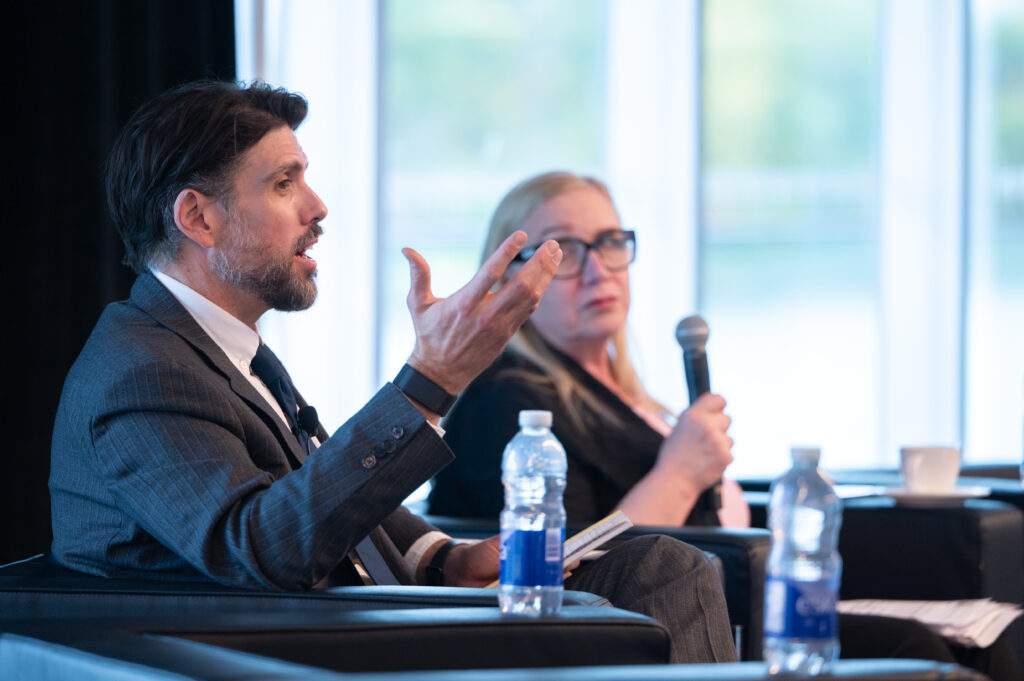
Highlights included:
– A dynamic foresight exercise, hosted by PERT’s Director of Policy & Research, Morgan Gagnon, and Policy Researcher Marlena Flick, and featuring a recorded introduction by the Government of Canada’s Chief Futurist, Peter Padbury. During the exercise, participants mapped out scenarios for the province’s labour market and the English-speaking community’s employment future. The session helped identify potential policy pitfalls and levers for positive change.
– Former New York Times correspondent Dan Bilefsky brought a critical outside perspective to the conference, exploring how the story of English-speaking Québec is told on the global stage. He challenged the room to rethink how the community presents itself—and how to leverage data and build a strong narrative.
– A panel discussion guided by PERT Executive Director Nicholas Salter featured panellists Alistair Price (Inicio), Allen Richards (CASA), Susanna Tang (Voice of English-speaking Québec), and Alex Hall (BCRC), who engaged in a dialogue about the unique effectiveness of “for us, by us” frameworks. They argued that when communities are involved in developing their own solutions—prioritizing peer involvement and local accountability— barriers fall and success increases. The takeaway for funders and policymakers was clear: improving employment outcomes begins with empowering the organizations that know their communities best.

A 5 Year Anniversary Celebration
We also marked our fifth anniversary at UP 25 with a video retrospective tracing PERT’s rapid evolution from a 2020 startup into a leading provincial voice. Over the last five years, we have moved from research and engagement into developing and implementing initiatives with our partners. The conference was an opportunity not only to take stock and look back at what’s been accomplished over the last 5 years, but also to serve as a collective reminder of where the organisation is headed.
An Opportunity to Connect
UP 25 also provided valuable networking opportunities. A highlight was the Circonflexe Networking and Mentorship Awards Night, honouring the impact of mentors and partners whose commitment strengthened confidence and supported professional growth for mentees throughout the province. It was also an opportunity to celebrate the mentees, whose perseverance allowed them to take major steps forward in their French-language learning journey.

Shaping the Future
Over two days, Unlocking Potential 2025 showcased both the challenges and opportunities for Québec’s English-speaking workforce. It demonstrated that closing the employment and earnings gap for Québec’s English speakers requires pairing a long-term policy vision with community-rooted action. By combining research, action-oriented insights, and community engagement, the conference left participants better equipped to collectively shape solutions to support the employability of Québec’s English speakers.
We thank everyone who joined and contributed to UP25’s success!
Share article


